Last week, the CIPL team joined two exciting panels and delivered a keynote address at the LDAPA’s Baltic Privacy and Innovation Summit.
Keynote Address: Evolving Data Governance for the AI Era: From Constraint to Clarity in Enabling Responsible Innovation
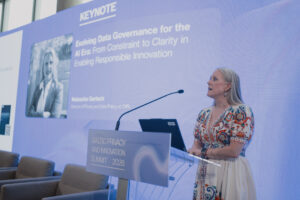
CIPL Director of Privacy and Data Policy, Natascha Gerlach delivered a keynote address on ‘Evolving Data Governance for the AI Era: From Constraint to Clarity in Enabling Responsible Innovation’.
As evolving definitions increasingly shape what is possible in AI training and deployment, Natascha’s keynote address examined whether current interpretations of personal and sensitive data, anonymisation, and pseudonymisation remain fit for purpose in an AI-driven world.
Natascha explored how an adaptive, risk-based approach can reduce uncertainty while supporting responsible innovation, and the role of this approach in ensuring that data governance frameworks can be evolved in ways that preserve trust and fundamental rights, without inadvertently slowing progress.
Simplification in Practice: Relief or Rebranding?

CIPL Privacy and Data Policy Manager, Lukas Adomavicius, joined a panel on ‘Simplification in Practice: Relief or Rebranding?’ Lukas joined the panel alongside Dijana Šinkūnienė (Valstybinė duomenų apsaugos inspekcija/State Data Protection Inspectorate of Lithuania), Antanas Liutkevicius (carVertical), Eglė Bakštytė (Nord Security), Professor Martin Zahariev, PhD (Dimitrov, Petrov & Co. Law Firm & University of Library Studies and Information Technologies), and Benediktas Girdvainis (Ministry of the Economy and Innovation), for a conversation moderated by Migle Dewsbury (Petkeviciene) (Sorainen).
The panelists examined whether the Digital Omnibus and broader simplification initiatives are ambitious enough to address Europe’s competitiveness challenges. They also discussed the latest legislative developments, which proposed measures are likely to have the greatest impact, and what gaps remain in the current proposals.
Protecting Youth Online: Can Age Assurance Deliver Without Compromising Privacy?
 Later in the Summit, CIPL Director of Privacy and Data Policy, Natascha Gerlach, moderated a panel on ‘Protecting Youth Online: Can Age Assurance Deliver Without Compromising Privacy?’. Natascha was joined by Prof. Dr. Rolf Schwartmann (Cologne University of Applied Sciences), Jekaterina Macuka (Datu valsts inspekcija/Data State Inspectorate of Latvia), Juras Jusenas (Oxylabs.io), Aleksander Tsuiman (Veriff), and Rasa Jauniškienė (Digital Ethics Center).
The panel explored the tension between effective youth protection and privacy-preserving age assurance, and asked whether current age verification mechanisms are fit for purpose across different platforms, age thresholds, and use cases. The discussion assessed the limits of anonymous approaches, the risks of over-reliance on bans, and whether Europe can design a framework that genuinely protects young people without expanding surveillance to the whole society or driving them to unregulated spaces.