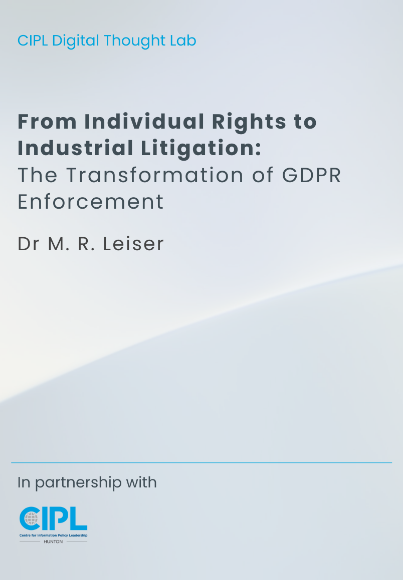
As GDPR enforcement evolves, so too does the role of collective redress. In this paper, published in partnership with CIPL, Dr Mark Leiser examines how collective redress operates alongside rising complaint volumes, increasingly systemic data practices, doctrinal uncertainty under Article 82 GDPR, and uneven national implementation across the EU.
Collective redress remains an essential component of the EU data protection framework. It complements public enforcement, addresses harms that individual complaints struggle to capture, and can enhance both accountability and deterrence. The paper’s focus is on how procedural design, fragmentation, and technological scale interact to shape enforcement dynamics across the Union.
Key insights include:
- The emergence of a bifurcated enforcement system, where public regulatory action and private litigation operate in parallel but not always in sync
- How collective redress acts as both an access-to-justice tool and an adaptive response to systemic data practices
- The growing importance and uncertainty of Article 82 GDPR as a driver of litigation strategy
- The impact of AI and automation in lowering the cost of initiating claims and scaling enforcement inputs
- Why the future of GDPR enforcement depends on calibration rather than retrenchment
The paper highlights a central challenge for policymakers, regulators, and courts: How to preserve strong access to justice while maintaining legal certainty, coherence, and proportionality in enforcement.
As collective mechanisms expand across the EU, the focus must shift to ensuring they remain anchored in demonstrable harm and aligned with the broader rule-of-law framework.
Download the Paper
Download NowMore like this
Mapping Updated Global CBPR and Global PRP Systems’ Program Requirements to the GDPR
Find out more
Key Takeaways: GDPR Procedural Regulation – One Year Later – Where Are We Now?
Find out more
The GDPR’s First Six Years: Positive Impacts, Remaining Implementation Challenges, and Recommendations for Improvement
Find out more
Bridging the DMA and the GDPR – CIPL Comments on the Data Protection Implications of the Draft Digital Markets Act
Find out more
GDPR Enforcement Cooperation and the One-Stop-Shop – Learning from the First Three Years
Find out more
How the “Legitimate Interests” Ground for Processing Enables Responsible Data Use and Innovation
Find out more
A Path Forward for International Data Transfers under the GDPR after the CJEU Schrems II Decision
Find out more