Our response builds upon last summer’s detailed submission, which first addressed the development of a Code.
The Draft Code reflects a number of the positions raised in our earlier submission, and we commended the OAIC for its responsiveness on issues related to the best interests of the child, age-appropriate transparency, and children’s autonomy.
Notwithstanding these measures, our latest response emphasized the need for additional clarity and further refinement on a number of issues, including the following:
- The ‘best interests of the child’ should serve as an overarching guiding principle. As drafted, the Code applies the standard to discrete data processing activities. CIPL sought the adoption of a more flexible, principles-based approach, as under the UK AADC.
- The Code should apply where the likelihood of access by children is significant. CIPL stressed the need to introduce a ‘significance’ qualifier so that the Code will apply only where children’s access is more than minimal and where processing presents a meaningful risk to their rights.
- The Code introduces a new “concerned with the activities of children” threshold. In addition to services likely to be accessed by children, the Draft Code purports to apply to services that are ‘primarily concerned with the activities of children.’ CIPL argued that this undefined term could include services (e.g., websites discouraging underage drinking) that do not process the personal information of children or pose any privacy risk to children.
- The Code fails to adopt a risk-based and outcomes-focused approach. Generally speaking, obligations appear to apply at the entity level, without an initial assessment of the type of service, the risks presented, and the mitigation measures in place.
- The Code’s consent architecture is highly prescriptive. CIPL recommended that the consent provisions be redrafted to focus on outcomes and to provide non-prescriptive guidance on how those outcomes may be achieved across different service types and user interfaces.
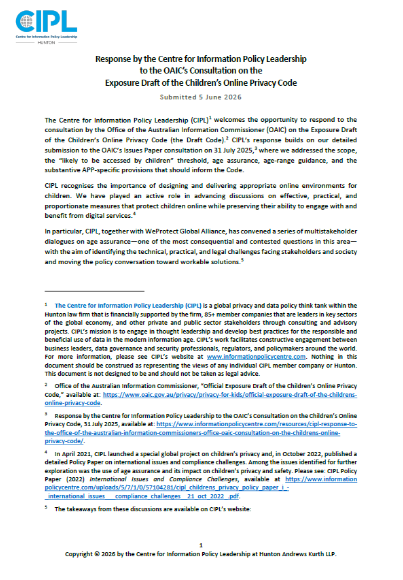
Download the Response
Download NowMore like this

September 2026
Establishing and Implementing Standards for Interoperable Age Assurance Solutions – Key Takeaways
Find out more
September 2026
CIPL Response to the UK Government’s Consultation: Data Regulation in the Age of AI and Other Data-Intensive Technologies
Find out more
September 2026
CIPL Response to the Department for Science, Innovation and Technology’s Call for Evidence: Data Flows You Can Trust
Find out more
July 2026
CIPL’s Response to the OPC Draft Guidance on “Assessing whether and how to use age assurance – Guidance for websites and online services
Find out more

July 2026
CIPL’s Response to ANPD Consultation on the Draft Guidelines on “Age Verification Mechanisms”
Find out more
June 2026
CIPL Response to the ANPD Consultation on Draft Guidelines on Suppliers of Information Technology Products or Services: Scope and General Obligations under the Digital ECA
Find out more
May 2026