On October 23, 2026, CIPL filed a response to the Colorado Department of Law’s October 6, 2026, interim draft rules implementing the Automated Decision-Making Technology in Consequential Decisions Act (the “ADMT Act”) and the Conversational Artificial Intelligence Services Act (the “Chatbot Safety Act”).
ADMT Act: CIPL supports the draft rules’ alignment with Colorado Privacy Act procedures, exclusions for low-risk administrative tools, and the commercial-reasonableness framework for meaningful human review. Our principal recommendations include:
- Refining “Materially Influence” to distinguish genuine human judgment from automated decision-making.
- Adding appropriate extensions to the 45-day response framework and clarifying interacting deadlines.
- Allocating notice obligations according to participants’ actual roles and control.
- Permitting categorical source disclosures where appropriate, protecting sensitive information, and recognizing equivalent federal disclosures.
- Providing optional model notices and correcting cross-references.
Chatbot Safety Act: CIPL welcomes the draft rules’ standards-based, privacy-preserving age assurance, proportionate scoping, prohibitions on misleading professional representations, evidence-based crisis detection, and tiered reporting. We recommend:
- Calibrating age-assurance obligations to service risks, improving access to referenced standards, encouraging the use of privacy-enhancing technologies, and clarifying transitions to adult status.
- Focusing AI disclosures on demonstrated user understanding rather than rigid timing requirements.
- Allowing consideration of protective measures and beneficial contexts for engagement-reward features, alongside clearer guidance on emotional-dependence safeguards.
- Separating public aggregate reporting from confidential technical details that could undermine safety systems if disclosed.
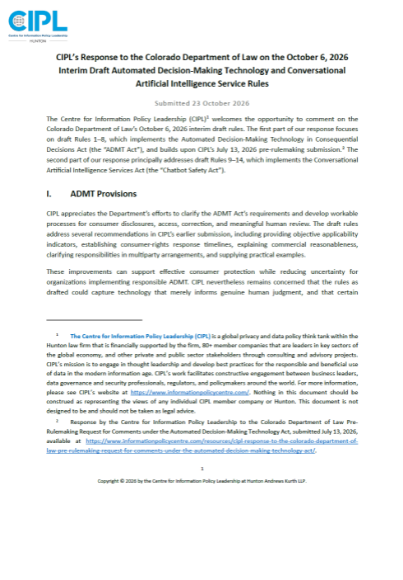
Download Our Response Here
Download NowMore like this

CIPL Response to the UK Government’s Consultation: Data Regulation in the Age of AI and Other Data-Intensive Technologies
Find out more
CIPL Response to the Department for Science, Innovation and Technology’s Call for Evidence: Data Flows You Can Trust
Find out more
CIPL’s Response to the OPC Draft Guidance on “Assessing whether and how to use age assurance – Guidance for websites and online services
Find out more
CIPL Response to the Colorado Department of Law Pre-Rulemaking Request for Comments under the Automated Decision-Making Technology Act
Find out more
CIPL’s Response to ANPD Consultation on the Draft Guidelines on “Age Verification Mechanisms”
Find out more
CIPL Response to the ANPD Consultation on Draft Guidelines on Suppliers of Information Technology Products or Services: Scope and General Obligations under the Digital ECA
Find out more
CIPL Response to the Office of the Australian Information Commissioner (OAIC) on the Exposure Draft of the Children’s Online Privacy Code (Draft Code)
Find out more