On 4 October 2023, the Centre for Information Policy Leadership (CIPL) published Ten Recommendations for Global AI Regulation, which offers guidance for policymakers and regulators seeking to advance the development and deployment of accountable, responsible, and trustworthy AI. CIPL’s paper recommends a risk-based approach to AI regulation that builds on existing laws and standards, such as privacy, consumer protection, intellectual property and anti-discrimination laws, as well as on accountable AI governance practices of organizations.
A few weeks later, on 30 October 2023, the G7 leaders announced that they had reached agreement on the Hiroshima Process International Guiding Principles for Organizations Developing Advanced AI System, which was first proposed at the G7 Summit in Japan in May 2023 to promote guardrails for advanced AI systems at a global level.
Also on 30 October 2023, the White House published an Executive Order on the Safe, Secure, and Trustworthy Development and Use of Artificial Intelligence, which establishes new standards for AI safety and security. The 36-page Executive Order (EO) is based upon eight guiding principles: ensure the safety and security of AI systems; promote responsible innovation, competition, and collaboration; support workers through job training and education; advance equity and civil rights; ensure consumer protection; protect privacy and civil liberties; attract, retain, and develop public service-oriented AI professionals; and engage with global partners to promote responsible AI deployment.
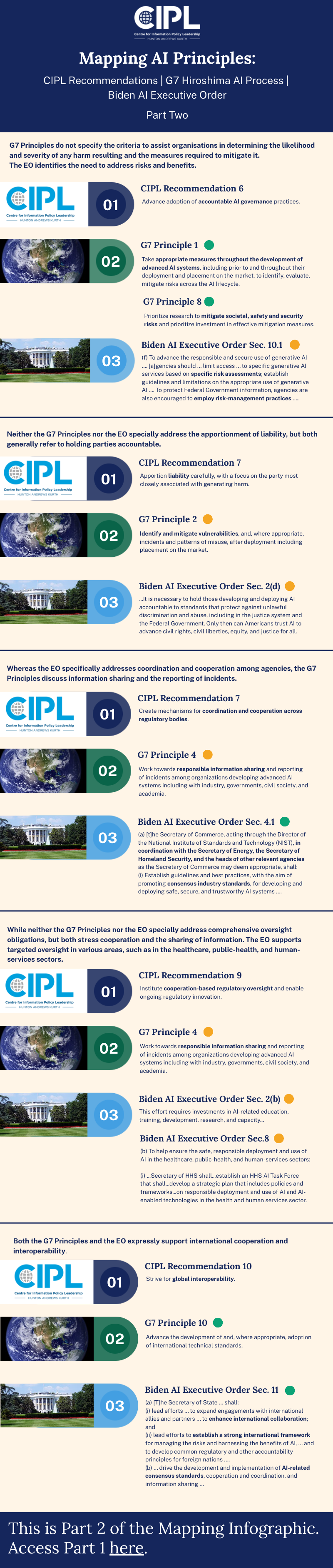
The infographics below identify whether and to what extent the G7 Principles and Biden EO align with each of CIPL’s 10 Recommendations. We used the red and orange markers to facilitate at-a-glance comparisons.
In sum, we found that the G7 Principles and the Biden EO largely align with CIPL’s recommendations, as both support a risk-based approach and accountable AI governance practices.
A few weeks later, on 30 October 2023, the G7 leaders announced that they had reached agreement on the Hiroshima Process International Guiding Principles for Organizations Developing Advanced AI System, which was first proposed at the G7 Summit in Japan in May 2023 to promote guardrails for advanced AI systems at a global level.
Also on 30 October 2023, the White House published an Executive Order on the Safe, Secure, and Trustworthy Development and Use of Artificial Intelligence, which establishes new standards for AI safety and security. The 36-page Executive Order (EO) is based upon eight guiding principles: ensure the safety and security of AI systems; promote responsible innovation, competition, and collaboration; support workers through job training and education; advance equity and civil rights; ensure consumer protection; protect privacy and civil liberties; attract, retain, and develop public service-oriented AI professionals; and engage with global partners to promote responsible AI deployment.
The infographics below identify whether and to what extent the G7 Principles and Biden EO align with each of CIPL’s 10 Recommendations. We used the red and orange markers to facilitate at-a-glance comparisons.
In sum, we found that the G7 Principles and the Biden EO largely align with CIPL’s recommendations, as both support a risk-based approach and accountable AI governance practices.

 RSS Feed